Other companies are focusing on ventilators, including SpaceX and Tesla, Dyson, Meditronic (doubling their capacity) and more.
Apple, Facebook and SalesForce donated millions of masks to healthcare workers and, with other tech firms, are sourcing more.
Burger King will provide two kid’s meals at no charge with a purchase from the Burger King mobile app. The link to the offer is on the home page and you must sign in to redeem. Pick-up only.
Online telemedicine providers enable patients to get face-to-face support. Many are provided at no charge for clinicians and patients. Contact your doctor or local hospital (by phone, please) for references. I’ll look more closely at this list in a few days.
Lots of folks delivering groceries to their homebound neighbors .. far too many to list here.
Neighbors helping neighbors .. time to plant tomato plants .. far too many to list here.
Oh .. CNN had a short story on “Victory Gardens” (link to the WWII war effort). The story cited community gardens springing up, as concern for trips to the grocery stores and supply chain risks may be growing. I cannot find that story at the moment, will update when I do.
There are a number of paid services out there for kids.
Not the least: our brave healthcare workers .. present, retired and volunteer, who are putting themselves and their families at risk by helping the rest of us.
Stay home for this lot so they can stay at work for us.
Caveat: “I’m not a Doctor ..“. I am a Technical Sales Strategist .. I’ll detail this at one point or another. Read on, please.
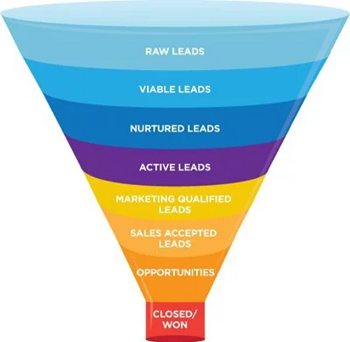
Our agents manage customer engagements, performing outreach to identify sales opportunities for our clients and move these opportunities along to close. This is typically represented as a funnel .. just like the one in your kitchen. Unlike the one in your kitchen, which gives you a wide opening to move something into a smaller opening, the Sales Funnel demonstrates how a large number of potential customers make their way to a closed sale. As you can surmise, not everyone who expresses an initial interest will actually make a purchase:
This does not relate 1:1 to the Coronavirus, but here’s a short analogy:
Total population: count
Total infected: count / percentage
Resolve on their own: count / percentage
Total hospitalized: count / percentage
Resolved in hospital: count / percentage
Don’t resolve in the hospital
As you may surmise, that is oversimplified .. and you might also guess, there are temporal (time) and severity aspects to these steps, i.e.:
Duration for self-resolution
Length of hospital stay (impacts bed, supplies and services utilization)
The severity for a hospital stay (impacts regular beds, ICU beds, equipment, supplies and services)
Ventilator required (much-needed devices, noting there is a finite count)
Length of time on ventilators (impacts available ventilators for the next patient)
Age of the patient
.. and lots more .. Intermediate things like turning beds, turning rooms, turning ventilators, and so on.
Last, each country has its own set of cases, differing start dates, climates, etc.
While trying to calculate the funnel, I stumbled across Worldometers: Coronavirus which broke out the top-line numbers nicely for me .. from there the percentages are easy to calculate .. but the denominators are unknown:
How many tests?
How many positive / negative?
How many resolved?
Facts matter. The numbers matter.
Please stay at home and protect everyone while you do your research.
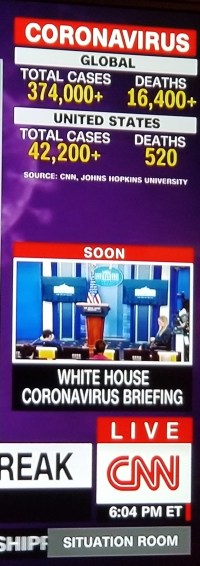
I snapped this at 1804 today (3/23/2020), right before the Coronavirus task force briefing.
Simple division shows:
Global: 16,400 deaths divided by 374,000 cases is a staggering 4.385% mortality rate.
US: 520 deaths divided by 42,200 cases is a horrifying 1.232% mortality rate.
In both cases, the denominators (the number of tests conducted that show positive COVID-19 results) are likely inaccurate. Lots of folks who may have (and are shedding) the virus are not being tested, as they’re not showing symptoms, and due to the shortage of tests and PPE, they’re not being treated because of this.
Unhappily, it’s likely that all the deaths are being tested (to ensure they’re not occurring for other reasons), contributing to the higher death count, and therefore, the percentage increase.
None of this is easy. There is a disproportionate number of deaths in Italy, but the average age is ~80. Then, there are way too many (well-attended) beaches open in The States with folks who can shed the virus (see above) .. who are contributing to the spread.
We’re social distancing here, and we’re making it work. We need to continue to make it work. I’m blessed with a job where WFH is possible for me .. I don’t have to endanger myself or others. Too many others aren’t so lucky .. WFH is not an option. Local support through take-out and services provide little comfort to this lot, which means the government needs to help make up the shortfall.
Last, I started this post at 2044 (three hours after I shot the first snap). I took another snap at 2107 with the Cuomo(s) (Chris of CNN and Andrew, Governor of New York):
In that short time, the US number has climbed to 541 deaths against 42,663 cases .. a more-horrifying 1.268% mortality rate. Each one of those represents a person. A loved one. Brother. Sister. Father. Mother. Friend.
Stay home, please. The spread is happening. Help us slow it.
We’ve all heard the term ‘Social Distancing‘ (link to the CDC). An excerpt:
While it may be disappointing to hear that so many sports events, cruises, festivals and other gatherings are being cancelled, there is a public health reason for these measures.
These cancellations help stop or slow down the spread of disease allowing the health care system to more readily care for patients over time.
They do. Think of crowded bars, cozy restaurants, queues at checkout lines .. if space is not managed properly we will continue to spread this damn thing at a terrifying pace. Right now, management falls to us, as individuals and families, and we must rise to this occasion.
Happily, today’s hyper-connected world enables to distance ourselves physically .. but not socially. Twitter, Facebook, NextDoor, WhatsApp, Skype, Tumblr, Instagram and others ensure we can stay connected. We must make use of these tools to interact: working, catching up, checking on loved ones.
As time goes by, we will find ourselves looking for those tasty dish snaps as we get more creative when cooking at home.
Even the phone plays a big part .. call someone.
In many ways, and with lots of evidence of Singing in Italy, Cook-a-Longs in Spain and evolving stories in The States: the mandated distance will bring us closer together .. online and from afar.
Reduced the number of gatherings (clubs and church).
Flown less.
Fewer events (note that many sports are canceled and movie theatres just closed today).
‘Social Distancing’ .. enforcing a six-foot distance between people.
Even with this, some are estimating, that without enforced ‘social distancing’, we are a week behind where Italy is (as of today Italy has 2,503 against 31,506 .. that’s a horrifying 7.9%!) .. we’re not even close, but must take the proper steps. We must ‘flatten the curve‘ through safe tactics so 1) fewer of us will get ill, and 2) it will spread out (in time) the folks who get ill so we don’t overwhelm the healthcare system.
Steps The States have taken:
Closing restaurants and bars, save for take-out / delivery (even with wine / beer) .. NYC was the first, Washington State right behind them.
‘Shelter in Place‘ (an emergency tactic to find a safe place indoors) just took place in San Francisco and may take place in NYC.
Canceling political rallies, and even elections (Ohio and Georgia have both postponed their primaries).
Ramping state-based facilities to process the tests.
I feel like as of today (March 17), the US Federal Government has seriously gotten into the game, after weeks of, well, not to a greater degree. This is encouraging, especially as they’re taking into consideration cash flow for hourly workers and small businesses (rather than a foolish and useless payroll tax cut). The airline and hospitality bail-out will be expensive to be sure .. may need to raise taxes.
Happy about the Federal engagement .. although it needed to be early enough (it’s a bit late), quickly enough (ramping effective programs rapidly) and completely enough (addressing enough of the citizenry and business). I am hopeful.
Tests? We need those too, and the means to get them back in short order (see The States, above .. Bravo!).
Thank you for reading! Please see “Why 5W?” for context, methodology and disclaimers.
BSS Overview
In a rapidly-evolving business landscape, businesses require support services to keep operations running smoothly. The Business Support Services (BSS) domain consists of vendors who provide Line of Business (LOB) packaged services to businesses, integrated through services to provide a common data infrastructure. This bears some explanation, as the definition above also applies to Enterprise Resource Planning (ERP) Systems .. the previous generation of Business Support Systems.
By contrast, modern SaaS-based ERP and BSS systems are significantly easier to deploy, enable mobile functions out-of-the-box and are better-received by end users. Through services-based API integration, these systems don’t require the rip-and-replace of any incumbent systems. My purpose for drawing this correlation is to point out that ERP and BSS essentially perform the same functions in an end-customer environment. However, legacy ERP is monolithic and tightly-connected to captive modules, whereas BSS achieves the same functionality through built-in integration, interoperability and mobile capabilities.
BSSs encompass a wide range of essential services, from accounting and bookkeeping to administrative tasks such as data collection, customer service and human resources management. By outsourcing these tasks to systems, businesses can focus on their core competencies and achieve growth and success.
Business Benefits
One of the significant benefits of leveraging BSS is the cost-effectiveness. Small and medium-sized enterprises often lack the resources to hire full-time employees for various roles, such as accounting and IT support. Outsourcing these tasks to BSS providers saves these businesses significant amount of money, where they will pay for only the services they require and reduce the need for dedicated internal support. The best part: BSS can enable businesses to access expertise and technology outside their core competencies, allowing them to do what they do best without worrying about LOB system overhead.
The segment BSS serves is full of business customers with a lot of LOB needs, including financial (AR / AP / Payroll), E-Commerce (OM / WM / Fulfillment), HCM (recruiting / talent management / project time tracking), Sales (CRM / MAP) and many more. Businesses can select from well-enabled, self-service vendors who have massive feature / benefit overlap, but few differentiators. The market is broad and confusing, but businesses need to explore it. Vital LOB functions in these spaces have their own challenges:
Financial processes demand automation and errors can be expensive.
Payroll rules are constantly changing, and businesses need to keep up to avoid incurring fines for non-compliance.
Consumer payment functions require PCI compliance and the fulfillment paradigm is complex.
HCM is a set of complex and manual processes for companies .. not without potential legal exposure.
CRM and MAP systems are typically ad-hoc and disconnected in the SMB space.
BSSs can formalize manual processes, and where incumbent systems exist, extend these functionalities through interoperability and integration.
BSS Capabilities
BSSs encompass all of the functions SMBs and MMEs require .. an easy target, as most of these functions are standard business processes, required by all businesses in most any space. As noted above, these include a wide variety of ‘standard’ business systems in the accounting realm, as well as extending into systems that a BSS customer may be performing manually, like recruiting, on-boarding, off-boarding, payroll .. as well as end customer-facing functions like E-Commerce, Marketing Automation (MAP) and so on.
BSS vendors bring all the benefits of SaaS right out of the box: modern architectures with built-in integration, SLA-based uptime, pay-as-you-go pricing, mobile device access and more. Services offerings, typically delivered by partners enhances the implementation experience and ensures businesses are functional in short order with predictable cost.
BSS Use Cases
The low-hanging fruit is payroll .. most all the vendors in the space offer it as table stakes. From there, other offerings emerge as vendors leverage their respective LOB experience to create a larger portfolio. As the space is broad and deep, please refer to ‘Companies in the Field’, below, for expansion on vendors and the services they support. Other BSS use case offerings include:
Customer Relationship Management (CRM) System:
Manages customer interactions and lead tracking.
Generates activity reports, sales reports and forecasts.
Monitors / Manages customer service and support requests.
Analyzes customer behavior and preferences.
Manages customer segmentation and activities for marketing campaigns.
Enterprise Resource Planning (ERP) System:
Integrates and automates core business processes like finance, inventory, procurement, order management, fulfillment and more.
Manages and tracks inventories.
Streamlines order processing and fulfillment.
Generates financial statements and reports.
Facilitates resource planning and allocation.
Human Resources Information System (HRIS) / Human Capital Management (HCM):
Manages employee records, including personal information, job history and performance evaluations.
Tracks inventory levels and optimizes stock levels.
Manages supplier relationships and procurement processes.
Plans and optimizes transportation and logistics.
Integrates with order processing and fulfillment.
Analyzes supply chain performance and identifies bottlenecks.
Financial Management System (FMS):
Manages financial transactions and accounts payable / receivable.
Generates invoices and tracks payments.
Creates and manages budgets.
Conducts financial forecasting and analysis functions.
Ensures regulatory compliance and generating financial reports.
Project Management System:
Create and manage project schedules and timelines.
Assign tasks and track progress.
Facilitate collaboration and communication across team members and connected teams.
Manage project resources and budgets.
Monitor and evaluate project performance.
IT Service Management (ITSM) System:
Manage IT service requests and incidents.
Track and resolve technical issues and outages.
Manage software and hardware assets.
Implement change management processes.
Monitor and analyze IT service performance.
Collaboration and Unified Communication Systems (UCaaS):
Facilitate team collaboration and communications.
Share documents and files in real-time.
Enable virtual meetings and video conferencing.
Manage and assign tasks.
Facilitate internal and external communication.
These are just a few examples of the various BSSs in the marketplace. Specific use cases will vary depending on the needs of the organization and any incumbent systems / processes to augment or replace.
The more an organization can integrate BSSs with other systems, the better the opportunity for reliable data collection. Quality, correlated data collections provide the means for an organization to significantly improve Business Intelligence and Data Governance efforts. These are compelling bonus opportunities to consider when assessing the costs and benefit to engage in a BSS implementation.
BSS Providers
Follows a list of BSS vendors with use case, vertical and media mapping. It is by no means complete, but provides offerings to support SMB / MMB space. The BSS story can be used as a vendor entry point for any of the underlying use cases, leading to BSS implementations.
Last, note that several of the offerings below are labelled ‘ERP’ .. but the differentiation from BSS functions (as described above) is largely semantic.
Solid Integration story .. lots of smaller applications; some standalone, others as integration kits.
ED: As Article Publish dates are frozen in time, it is quite possible reviewed vendors and their capabilities may have advanced beyond those presented herein. Please accept my apologies for my shortcomings. A note to vendors: please reach out to update your current offering capabilities and I will update.
BSS Audiences
A BSS implementation is not industry-specific. Virtually every industry need this toolset. Some highlights:
Retail and E-commerce:
Manage inventory, track sales and streamline order processing and fulfillment.
Facilitate customer relationship management, marketing campaigns and loyalty programs.
Manufacturing and Supply Chain:
Track and optimize production planning, inventory management and procurement processes.
Appointment scheduling, staff scheduling and electronic health records (EHR) management.
Billing and insurance claims processing as well as supporting inventory and supply chain management.
Telecommunications:
Customer relationship management for service providers.
Billing and invoicing, service provisioning and network performance monitoring.
Professional Services:
Project management, time tracking and resource allocation in consulting firms, law firms, and other professional service organizations.
Client billing and contract management.
Education:
Student enrollment and registration, academic records management and grading.
Course scheduling, resource allocation and learning management systems.
Transportation and Logistics:
Optimize route planning, fleet management and shipment tracking.
Warehouse management, inventory control and transportation logistics.
These are just a few examples of industries that can benefit from implementing BSS. The specific needs and requirements may vary within each industry, but the underlying goal is to streamline operations, improve customer satisfaction and improve the bottom line.
BSS implementations will benefit for a wide range of audiences within a business organization. Some key audiences that can consider the value:
Executive Leadership:
Access to accurate and real-time data for making strategic decisions.
Insights into the organization’s performance, financial health and market trends.
Operations and Business Managers:
Streamline and automate core business processes.
Enhance efficiency, reduce manual work and improve process visibility, allowing managers to optimize resource allocation, monitor performance, and drive operational excellence.
Sales and Marketing Teams:
Track and manage customer interactions, leads and measure campaign effectiveness.
Provide a centralized customer database, sales forecasting tools, and marketing analytics, empowering teams to enhance customer engagement, improve conversions, and drive revenue growth.
Customer Service and Support:
Manage and track customer inquiries, complaints and service requests.
Access to customer activity, ticketing systems and facilitate knowledge sharing to improve response times and better issue resolution.
Human Resources:
Manage employee records, automate HR processes and improve workforce management.
Streamline recruitment, onboarding, time and attendance tracking, payroll management, performance evaluations and training, all leading to increased efficiency and employee satisfaction.
Finance and Accounting:
Streamline financial operations, manage accounts payable / receivable and generate accurate financial reports.
Automate invoicing, payment tracking, budgeting, expense management and regulatory compliance, thus improving financial visibility, accuracy and control.
IT Departments:
Provide self-service IT capabilities, manage IT service requests, incidents and assets.
Automate ticketing, asset tracking, change management, performance monitoring to improve IT services.
Specific audiences may vary depending on the organization’s structure, industry, and specific business needs.
Conclusion
Whether CRM, ERP, HRIS, OM, MAP, EC, WM, FM, SCM .. or a variety of other BSS alphabet soup, an appropriate BSS implementation will result in improved processes, error reduction and smoother operations. BSS plays a crucial role in enabling businesses to thrive and adapt in today’s competitive and dynamic business environment.
Thank you for reading! Please see “Why 5W?” for context, methodology and disclaimers.
Technology Overview
Customer Data Platforms are recent aggregation / expansion capabilities realized through the integration of customer interaction support software, enabling a company to compile a 360-degree view of customers and prospects. Armed with this information, Marketing and Sales can make relevant and personal connections to prospects to increase conversion rates.
Companies will recognize the usual suspects of potential component systems that can contribute to a CDP effort:
Social Media Engagements
Marketing Automation Platform (MAP)
E-Commerce Systems
Enterprise Resource Planning Systems (ERP)
Customer Relationship Management Systems (CRM)
Customer Support Systems
Customer Experience Management (CXM)
Warehouse Management Systems (WMS)
Order Management Systems (OMS)
Fulfillment Management Systems (FMS)
CDPs provide a configurable means to connect, aggregate and combine data across disparate systems guided by business-facing definitions from Sales and Marketing. Once deployed, a CDP should require minimal IT intervention, provided the CDP enables business users the capability to combine and view real-time data to test and confirm hypotheses on their own.
Note that CDP integrates with on- and off-premises systems and cloud providers. CDP is an emerging technology use case and will require education and nurture efforts to engage end customers.
Business Benefits
Companies store customer data and interactions in an ever-growing variety of disparate systems, most of which are marginally, or not connected to each other at all.
As an example, Marketing and Sales recognize the value of having the latest customer transactions, preferences and communications data available to them, along with current inventory levels, order and delivery statuses, account balances, credit status and so on. While these data can be combined through manual system search and interaction, a manual effort is time-consuming and represents risks, not only security (through multiple system exposure to out-of-department audiences) but contextual data inaccuracies (relating the wrong data to transactional events, ensuring the data is up to date, and so on). CDP helps to manage this by making connections through configuration .. not coding, automating data retrieval, assembly and presentation of the most current data to the business user.
Determining which data to combine requires visibility into the business processes and customer / prospect interaction goals of the target audiences .. the people who can benefit the most from aggregated business data. Note that all companies have these interaction goals, but they may not necessarily be stated, reviewed, aligned or published. Further, helping non-technical audiences understand the business benefits of CDP in their environment will require education, mostly through use-case based engagements, where offering sellers present use cases demonstrating how a CDP can enable business benefits in their environment.
In short, a CDP combines these data, enabling thousands of business of use cases to improve customer service, accelerate conversions, document performance and more. Some examples are presented in Use Cases, below.
CDP Capabilities
To play in the CDP space, a vendor offering must:
Provide configurable connectivity to organizational systems, whether cloud, on-premises, database, LOB, etc.
Collect and transform data from connected systems, storing as necessary (not all systems will allow real-time access, nor may it meet necessary performance requirements to do so).
Create / Associate Data Consumer identifiers across these systems to surface customers in context.
Define:
Consumer profiles and groups, assigning appropriate permissions and workflows.
Internal audiences, role-based access control and the depth of data to view when published.
Segment Consumers into meaningful ‘buckets’ for workflow activities and content distribution.
Provide the capability to switch on / off connections across systems as business needs / opportunities emerge .. without IT assistance.
Manage and expand Consumer / Audience profile over time to improve views and visualizations.
Ensure connection and end-to-end security / privacy / auditing of acquired / stored data.
Publish Customer and Audience Data across tools for consumption by appropriate audiences within an organization.
Through these capabilities, a single source of truth will emerge, along with enabling a 360-degree view of a specific customer or group. This increases confidence within the consuming audiences and empowers them to make better, data-driven decisions when working with customers.
Some examples are presented below.
Use Cases
While each company will have specific use cases to fulfill, many aspects will fall into semi-standardized buckets. The real impact of CDP is in connecting across systems, enabling out-of-application audience users to see data from other systems in a controlled and secure manner.
Some samples to get creative juices flowing .. the sub-bullets in the first example are the discrete steps and systems with which a user would engage manually to create the outcome:
Customer Support – Customer Complaint: Address a product complaint and create a CRM Task, assigning to a Customer Service Agent for resolution. The source of the complaint could be a call, a tweet, an email, an online form, etc. The CDP can perform the following discrete steps:
Look up the customer ID in the customer database (note this could be in the Customer Support CRM or in a separate Customer CRM). This may require the Twitter handle, email address or customer name to identify the customer.
Retrieve the customer invoices from the Invoicing System using the Customer ID.
Identify the proper invoice based on the product in question.
Confirm the product was ordered in the Order Management System (OMS).
Confirm the product was shipped in the Fulfillment Management System (FMS).
Identify if the product is still under warranty and can be replaced.
If the product can be replaced, check the Warehouse Management System (WMS) to see if the item is in stock and can be shipped.
Create a task containing the data above in the Customer Support CRM and assign to a Customer Support agent.
Executing these steps enables a Customer Support agent to reach out to the with a specific resolution to the customer issue, the ability to address the issue directly and provide a solution in the first contact with the customer. This level of personalized interaction ensures customer satisfaction.
A CDP provides connectivity and automation, designed and configured by a business analyst (not IT) for each of these tasks. This enables customer- and agent-friendly resolutions to customer support issues. Further, the data collected across all these systems provides massive Business Intelligence opportunities for an organization.
The remainder of these use cases are referenced right-to-left, without the intermediate steps. A CDP offering should be sold by presenting use cases that resonate with a target customer, likely leading to a Discovery Call.
Marketing – Improve Marketing Orchestration: Capture feedback in real-time across all channels (MAP, Sales, E-Commerce) by collecting data aligning to MAP outreach to determine marketing effectiveness.
Marketing – Improve Marketing Communications: Capture real-time feedback from marketing campaigns as potential customers are engaging with marketing content. Marketing can gauge which messages are more effective.
Marketing – Perform / Streamline A/B Tests: Drive marketing moments / capture the results of product enhancements in real time by initiating multiple (two or more) actions simultaneously, capturing the results and feedback in real time to determine which combination of messaging and the channel is more effective.
IT Governance – Improve Customer Data Quality: One source of truth .. the process of connecting and correlating disparate data systems enables CDOs with a solid foundation of tracking internal audiences with access, and controlling the data these audiences can see.
Operations – Improve the Customer Journey: Integrate with CXM and MarTech systems to isolate and clarify how a customer got into the stages .. how quickly and how effectively .. all the way through conversion and fulfillment.
Sales – Current state of the Customer: Present an all-up customer view for a seller on their way into a customer meeting. Captures content across systems: confirming the latest orders have been shipped, invoices have been paid, customer support issues have been resolved, etc., all prior for the seller arriving in a face-to-face meeting with the customer.
To assemble the data In all of these (and other) use cases, internal systems must be accessed by out-of-audience entities, which, if performed manually is time-consuming, creates security risks and could be filled with outdated / erroneous data. A CDP standardizes these interactions and provides a unified view, by audience for these data.
Hidden Gem: Besides enabling Operational and Business Intelligence opportunities, a robust CDP implementation creates a framework for Data Governance use cases.
CDP Providers
A great many companies claim CDP capabilities (CDP Vendor Segment cites ~80), but most are add-ons to their existing LOB systems and not ‘pure’ CDP plays. These include the bulk of the larger ERP companies, as well as more than a few Integrated Platform as a Service (iPaaS) / Hybrid Integration Provider (HIP) vendors.
Companies making a CDP claim run the gamut of functionality from configurable connectivity, accessing in-flow data streams, reporting and / or creating persistent, referenceable repositories to ensure interactivity and access to aggregated data. A partial list follows, where only ‘pure’ CDP plays are included:
Presents as a unified customer data management, compliance and customer journey orchestration platform, including analytics and machine learning to drive personalized engagements.
Focuses on using CDP to personalize experiences for every step in the Customer Journey. Includes several customer-centric us cases, including acquisition, engagement, upsell, win-back and renewal. Integrations for the retail, CRM and MAP spaces. Looks more like enlightened MAP.
Focuses on CXM and improving the Customer Journey. Rich integration framework and SDK to support beyond MAP and CRM. Offers a 60-day services engagement to get started and a Gated Demo.
Frequent updates to this section as new vendors emerge.
ED: As Article Publish dates are frozen in time, it is quite possible reviewed vendors and their capabilities may have advanced beyond those presented herein. Please accept my apologies for my shortcomings. A note to vendors: please reach out to advise your current offering capabilities and I will update.
CDP Audiences
A few enlightened prospects will recognize CDP by name, slightly fewer will recognize it by the integration opportunity CDP provides. As per, the majority will need to be engaged through education, tailored to their role in an organization and the benefits of exploring CDP for business benefit.
Most customers will not recognize an immediate need for a CDP, likely citing their CRM or Customer Support Systems present these data. To a point, they’re accurate. These systems provide the present customer / prospect state to the primary audience of the system .. but not to the secondary audiences who could benefit the most from knowing all the data about their customer.
CDP connects a wide variety of business platforms creating virtually infinite use cases, so discovery is an important part of an engagement. A seller can approach prospective CDP client by describing the value of CDP integration to create Business Intelligence Use Cases, enabling a seller to map a story to prospect systems do demonstrate business value, including:
Value of configurable system integration and the virtuous cycle enabled thusly.
Data Governance (hidden gem .. solves two business challenges with one implementation) benefits, where CDP exposes access and management control opportunities across systems.
Dashboards and Beyond, delivering relevant, interactive and secure information to the proper people at all levels in an organization.
Agility and Flexibility, enabling Citizen Analysts / Marketers to review data that is most relevant to them.
Speed to Business Value: data-driven business benefits can be realized with the first connections between systems.
Important note: CDP is not ‘rip and replace’ .. CDP integrates with incumbent systems, databases and file-based repositories.
CDP is not a technical sale .. it is creative and educational, relying on sellers identifying, researching and offering use cases that align to prospect roles within the target organization.
As the CDP space is early stage at the time of this writing, opportunities within are mostly greenfield .. but will require discovery, education and nurture to make an effective case to decision makers in a target organization. CDP prospects will already be combining some of these data, albeit manually. It is important to demonstrate the value to the specific audience in time savings and improving the quality of data presented to users.
Note there will be a fair bit to unpack as customer environments will contain incumbent systems, most of which store customer data. On this, please recognize that access to any systems containing customer data must be managed appropriately, as GDPR and CCPA constraints may be in play. A seller must inventory the present state to realize the scope of the existing environment, recognizing incumbent systems and integration opportunities therein .. all while pointing out how CDP will manage any potential privacy breaches.
A company should consider a CDP for:
Consolidating / presenting an all-up view of a customer in a single place, securely, and to relevant audiences.
Capturing a more granular understanding of customers.
Consolidating / switching analytics or marketing systems / vendors.
Personalizing customer experiences.
Unifying messaging across all channels.
A seller needs the ability to recognize, expand and document end-customer use cases / need states that enable them to secure a solid prospect.
Primary CDP audiences include:
Marketing
Product Owners
Customer Support Organizations
Sales (capturing an all-up customer view)
Analytics
Expect these audiences to expand through digital-driven CDP engagements, which will surface hand-raisers and other interested entities within end-customer organizations.
Primary Targets for CDP implementations are not necessarily aligned to specific industries. Targets include companies who:
Have connections between ‘some’ systems across ‘some’ non-primary audiences. This will manifest itself with companies that have connected MAP and CRM systems to power active outreach. Note that Sales and Support are left out, presenting the opportunity for us to advance use cases when other systems can be connected. Treat this as gap analysis, where other systems can be brought in to improve customer context and relevance.
Can recognize the business value to be gained by connecting disparate systems. This is use-case specific, and should be workshopped with prospects to demonstrate value.
Are expanding from tribally-supported Sales / Marketing use case feedback loops to their audiences, but don’t expose content to audiences beyond the bits a data consumer already ‘knows’ about their customer base. It’s important to advance the concept of exposing these data to identify gaps in the customer knowledge base.
Seek to formalize an approach to exposing end-customer data across multiple, incumbent systems, mapped to specific internal audiences. This represents a longer sales cycle, but enables a seller to demonstrate expertise in the space.
Again, CDP is in the educational phase. CDP is a combination of existing systems and use cases .. many of which companies may be doing manually on their own. CDP provides the connectivity, automation, data aggregation and presentation layer to get the right data to the right audiences at the right time.
Conclusion
CDP provides an interesting and accessible means to integrate across multiple systems, securely exposing integrated data within a single interface through low-code and configuration, versus code, multiple logins and reporting capabilities requiring manual manipulating to gain business value.
Thank you for reading! Please see “Why 5W?” for context, methodology and disclaimers.
Quote to Cash Overview
The Quote-to-Cash process (also known as Q2C or QTC, the latter I am using as the acronym in this article) is a set of business processes that includes product / offering selecting, quoting, pricing, up-sell, contracting, invoicing, integration with payment systems, contract renewal and more. We should all recognize that reducing friction after the sale is a critical component to engaging delivery, achieving revenue targets and getting paid. In an ideal world, QTC would be automated and heavily integrated with all component systems and dependent systems.
Given the importance of streamlining revenue-associated business processes, it is surprising to note that many companies have not effectively automated or standardized their QTC processes. While some businesses have standardized some of them .. others have selected or inherited multiple SaaS-based systems over time, and still others rely on separate processes. However, there is a significant lack of end-to-end integration for QTC in most businesses.
You might also have heard of Order to Cash (OTC). While the terms may be used interchangeably, OTC and QTC are different:
OTC likely does not include configuration capabilities for the product / offering, like setting the price, creating a quote, or any bits associated with Contracts and Contract Renewal. OTC tends to be at the order level, where these items are simple (quantity, color, etc.), or already identified.
QTC encompasses a much larger set of business processes and as noted above, may well include OTC bits for scoping, pricing, logistics and delivery.
An effective QTC implementation will be tightly bound with company Enterprise Resource Planning (ERP), Configure Price Quote (CPQ), inventory and Point of Sale (POS) Systems for brick-and-mortar establishments. If the organization transacts business online, an E-Commerce System acts as POS, and a Customer Experience Management (CXM) System can provide significant Business Intelligence (BI) value by tracking customer interactions on the site, capturing buying patterns and interest in other products for future cross-sell / up-sell outreach.
If the organization lacks native (or effective) integration across systems, it can consider deploying Robotic Process Automation (RPA) as an effective stopgap to connect other systems to a QTC system while integrations are built.
QTC Business Benefits
QTC falls on the right-hand side of a Supply Chain Management (SCM) diagram, where an end customer has selected / described a finished product / offering and is entering purchase / contract / services negotiations. Note that in a retail E-Commerce transaction, there is typically little complexity on this: select the item, customize, click the quantity, enter payment and shipping information and the product shows up. For more complex offerings, scoping, customization, integration with external systems, current-customer discounts and much more will require much more detail when finalizing an purchase.
Consider QTC enabling / automating a complex set of transactional steps, including:
This list is not complete and will vary widely across companies.
ED: As Article Publish dates are frozen in time, it is quite possible reviewed vendors and their capabilities may have advanced beyond those presented herein. Please accept my apologies for my shortcomings. A note to vendors: please reach out to advise your current offering capabilities and I will update.
QTC Capabilities
Many E-Commerce transactions automate the early stages of this (Product / Offering / Configuration / Scoping, some quoting), but as the bulk of these processes involve disparate systems (including internal systems like Contracting, Financial and Warehouse Management), E-Commerce can (and should) only go so far in the overall QTC scope.
QTC transactional steps touch multiple systems in the Seller environment:
Order Management
Configuration Management
Quoting (CPQ) Management
Contract Lifecycle Management (CLM)
Credit Management
Warehouse Management (WM)
Accounts Receivable (AR)
Payment Management.
.. and so on. Automation is the first step, but integration is the real key to accelerating the entire scope of QTC to business benefit.
The QTC process is comprised of discrete steps, a subset of which are described above. A QTC system that integrates, automates and governs transactions, including policy-based logic, approval routing, notifications, and providing an all-up process view is a major benefit to an end customer. A quote from the Aberdeen Group (provided by BlackCurve) cites QTC ROI is significant, resulting in:
105% larger deal sizes.
49% higher proposal volume
28% shorter sales cycle
26% more sales representatives meeting their targets
17% higher conversation rate
These benefits are largely due to streamlined, interconnected and error-free automated processes. Please note the numbers above were extracted from QTC systems across multiple sales organizations and across all industries. End customers should take a serious look at QTC to achieve this kind of reporting alone .. most organizations can search across systems to validate these findings in their present environment.
Addressing the automation and interconnectivity use cases in the ‘Business Challenges’ section above will aid in the selection of a QTC offering, as each represents a checklist item to be confirmed in an end-customer environment during discovery.
Organizations with robust Supply Chain Management systems will recognize the opportunity to improve in-chain payment processes by expanding the scope of the QTC process to include Trading Partners for whom they are a Provider or a Seller.
QTC Use Cases
QTC is effectively its own use case, speeding the process between initiating, configuring, pricing and closing on a sale to receive revenue. Granted, you’ll note a lot of complexity across a large number of systems that describe a complete solution.
QTC Providers
The major ERP, CRM and SCM players have a QTC offering or integration / implementation:
CRM provider. Acquired SteelBrick in 2015. SB built QTC as an SFDC application.
ED: As Article Publish dates are frozen in time, it is quite possible that reviewed vendors and their capabilities may have advanced beyond those presented herein. Please accept my apologies for my shortcomings. A note to vendors: please reach out to update your current offering capabilities and I will update.
QTC Audiences
A QTC engagement is unlikely to be greenfield, as some automation, on-premises or SaaS silos will likely exist. It will also cross multiple audiences within an organization, including:
IT
Contracting
Quoting
Finance (AR / AP)
E-Commerce Platform Owners
Logistics and Fulfillment Roles
.. and all the way to the executive suite.
A modern QTC offering should have no issues connecting with modern SaaS silos via API or RPA. This is a solid benefit to call out as end customers will be rip-and-replace averse when engaging with critical legal and financial systems. Initial engagement will include:
Discovery of the current order, fulfillment, payment systems, plus business workflows.
Capture integration points (by name and integration method).
Document the present workflow as part of solution planning.
Some reluctance will surface as many will cite some of their processing components are working well enough to suit their needs. This posture will manifest itself early in a conversation, especially among operators of ‘in the chain’ components. While a company-wide QTC effort will be driven from the top, there is still value in engaging with operational entities within an organization to ascertain process, performance and contract intelligence.
Common Customer Objections include:
QTC is expensive: Cost is relative, and like any investment in business technology, a customer must examine the ROI of the purchase against the potential value the technology and disciplined business processes will bring to the company. There are many SaaS-based QTC offerings with robust integration points offering process improvement without a rip-and-replace requirement.
QTC is complicated: The short version: it is. As QTC requires discipline both in process management and integration, suggesting a dedicated resource or a partner to assess and execute. QTC is connecting, configuring and NOT coding in over 75% of the use cases, and creates huge time savings when deployed. It is not all sunshine and roses .. if systems that cannot be integrated (siloed, lacking APIs or are paper-based) are in the process, you may not be able to eliminate some manual steps in the first iteration.
QTC is overkill: Many organizations may feel they’re too small or not complex enough for QTC. Tease this out in Discovery .. if the customer has a quoting and approval process, they will benefit from QTC capabilities.
We lack the bandwidth to deploy QTC: See ‘complicated’, above. There are companies who can assist with this.
We already have QTC: I appreciate it when an organization has an existing implementation as it results in a shorter education cycle and lets us engage more directly. Through Discovery, unpack the extent of their implementation, any components are getting old / need updating, or don’t play well (integration or reporting) with others. You may also be able to expose opportunities for QTC within their SCM implementation, as noted in ‘capabilities’, above.
Not an objection, but a QTC implementation isn’t typically do-it-yourself. Most organizations will recognize this, so it is important to have engaged Partner Sellers to provide Services in these engagements.
Conclusion
You may surmise QTC is a less common implementation in companies and not likely a greenfield solution. Companies will have manual or semi-automated processes, each with a process discipline. QTC is an enabling technology within E-Commerce, Logistics and Fulfillment platforms, so industry / vertical is less important than how the customer transacts business.
Some offerings are more end-to-end than others .. but note: as flexible Integration is a requirement for a QTC offering, an end customer can select and right-size a solution that has just the features they seek at a price point they can afford. Most of these are SaaS-based, allowing for a low barrier to customer entry and flexible entry / escape paths.
 Our agents manage customer engagements, performing outreach to identify sales opportunities for our clients and move these opportunities along to close. This is typically represented as a funnel .. just like the one in your kitchen. Unlike the one in your kitchen, which gives you a wide opening to move something into a smaller opening, the Sales Funnel demonstrates how a large number of potential customers make their way to a closed sale. As you can surmise, not everyone who expresses an initial interest will actually make a purchase:
 I snapped this at 1804 today (3/23/2020), right before the Coronavirus task force briefing.
 OpsanBlog