California court gives immunity to bloggers

Last week, MSNBC reported the California Supreme Court ruled that bloggers and participants in Internet bulletin board groups cannot be sued for re-posting defamatory statements made by others.

This case has been watched very closely by free speech groups and provides the same protection that internet service providers receive for hosting content posted by others. From the article:

The case involved a lawsuit against Ilena Rosenthal, a women’s health activist, who created an e-mail list and a newsgroup (alt.support.breast-implant) to discuss issues related to breast implants. Six years ago, she posted a letter written by a man who was highly critical of the efforts of a doctor to discredit advocates of alternative health treatments.

In the letter, the doctor, Terry Polevoy, was accused of trying to get an alternative medicine radio program canceled by using "scare tactics, stalking, and intimidation techniques" against the program’s producer. Polevy, who maintained a website himself to expose what he called "health fraud and quackery" sued Rosenthal for libel.

Rosenthal argued she did not write the letter herself, posting the work of another to the news group.

I’m not a legal eagle, but I would tend to apply this ruling to comments made by others to my posts, as well as comments made to other comments. While I moderate comments on this blog, visitors have made inflammatory statements about others, for which I should not be held responsible. I ask those who make comments to stay on topic, and avoid stupidity.

Read the entire article: "Calif. court says bloggers can’t be sued".

Life of a ‘domainer’

Some time ago, I talked about the buying and selling of domain names in "Have you heard of ‘Domain Kiting’? I hadn’t".

A ‘domainer’ is one who registers, buys and sells domain names for fun and profit. It’s not illegal; it’s not bad. Just another way to make a profit. Like any opportunity, there may be some questionable practices, but that’s not the point of my post.

To learn more, read the blog of John Chow giving us some interesting details in his "Making Money with Domain Names" post.

007 by day, Darth Vader by Night

Or is it the other way around?

This is a picture of my grandson, Christian Michael from a recent wedding (no, not his own, and no: he wasn’t really playing James Bond) and his Halloween costume:

ChristianJamesBond20061124

EBay Phish

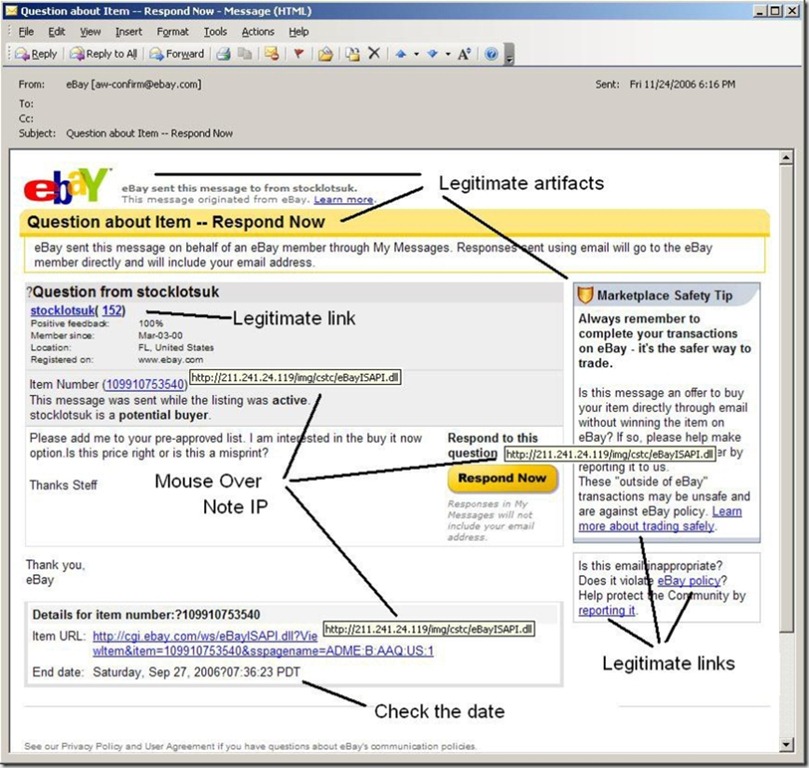
Another classic, this time, targeting an EBay seller:

phishEbay200611246

Some notes:

  • Mouse over the action button and links and you’ll see an IP (instead of an EBay link) in the URL preview.
  • Mouse over the item URL and you’ll see an IP (instead of an EBay link) in the URL preview.
  • The button is served from EBay, as are the colors and EBay icon.
  • The buyer link is legitimate.
  • The reply-to address is accurate.

Not a bad phish, of course, it would have been nice if

  1. I was actually selling something on EBay.
  2. The end date of the auction wasn’t almost two months ago.

Don’t fall for these, folks.

Lego Thriller .. Thriller Night

Given Hunter’s Joy of Lego: here’s a YouTube video of Michael Jackson’s Thriller, all done in Legos: ‘"Thriller"… with Legos‘.

The next thing: Mobiles, Minis, Flakes, et. al

I’ve been seeing this coming and talking about it internally for the past few months, driving my co-workers nuts. I have even posted about the concept a number of times.

Well, it’s here: the concept of a ‘universal landing page’ that users can own and add the content that suits them.

While I don’t have a name for the landing page myself (I’m sure there is one out there somewhere; ‘uber personalized site’ is so clumsy), I’ve been calling the consumption of these data “Information Snacking“.

Information Snacking is how users consume their data; whenever, wherever they please. It’s stock quotes on the run, email on a bus and alerts / notifications anytime. The convergence of broadband, content and devices makes this possible, and users will demand this, with a vengeance.

Among the other things they’ll demand:

  • Absolute control over the data they choose to snack upon.
  • Absolute control over the venue when they snack.
  • Freedom to grab content from a variety of sources.

While I’m not declaring the world of web portals dead, the landing page concept provides users the flexibility to select the data they want from a variety of competitive sources.

Here’s the concept. Imagine a single page that supports:

Let’s look at the list.

  • News and the latest bits from Slashdot are pretty obvious. But, if the user has Yahoo Finance, why the link to Schwab? Perhaps this user (okay, it’s me) has an account at Schwab and can get real-time quotes by passing credentials to the feed, instead of the standard 20-minute delay.
  • Same with email: why would the user need two email accounts on this page? First of all, convenience: avoiding the need to log in to separate web pages when, at a glance, they can see if they’ve mail. They’re one-click away from their inbox.

So, what’s wrong with the current portals? Nothing. I enjoy http://my.msn.com/ and http://my.yahoo.com/. However, I cannot do cross-pollination between the mail services at present, or add MSNBC to Yahoo, and so on (and so on, and so on).

“What a great idea!”, you might say. “Why isn’t anyone doing this?”, you might ask. Well, there are a few sites out there that provided these types of landing pages, including services from the majors (and lots and lots of minors) are appearing every day. However, the smaller sites couldn’t make the numbers work, and one by many, disappeared. I can verify that PageFlakes is still up and running if you want to see the concept for yourself.

You’ll see that each of these offers a variety of ways to link to content that is acquired off the landing page. Users WILL create accounts on one (or more) of these sites, and customize to their hearts’ content. These sites will eventually be ‘smart’ enough to provide the rich personalization experience even on a mobile phone or the 10′ experience enjoyed by Windows Media Center.

Speaking of mobile .. it’s quite possible that mobile devices are torpedoing these pages on the web. The mobile device is, by it’s very nature, an Information Snacking device .. a composite application, with you as the center.

Pick your landing page or your device, connect your data and snack away!

Telemarketer Repellent

We’ve all had those calls; usually right around dinner time, or when you’re up on a ladder or in the restroom or playing with your kids or thinking through a document or something.

The phone rings. "Is this the person in the household who .. "?

LifeHack posts "Top 10 Telemarketer Repellant".

There’s some good ones therein. My repellent is to declare that I’m in the business of whatever they’re selling and give them this:

I’ll have you know I’m a professional xyzzy. You guys blow through town, taking the food out of the mouths of my children. You blow out of town, leaving dissatisfied customers in your wake which makes it all the harder for me to earn a living at what I do best. You should be ashamed of yourself.

Depending on my mood, I’ll either play weepy or angry.

Gets ’em every time.

Putting an end to "Hamburger Management"

Adrian Savage is a writer who just published "Slow Leadership: Civilizing The Organization". He describes "Hamburger Management":

Hamburger Management is a shoddy, debased version of real leadership that focuses on just three things: whatever demands least, can be used fastest, and costs least. It thrives wherever organizations seek to meet unrealistic targets with insufficient resources to maximize short-term profits. Indeed, Hamburger Management is short-term by nature, and will habitually sacrifice long-term advantage and value for the immediate gratification of bosses and investors.

Spot on.

LifeHack: ‘Why We Should Put an End to “Hamburger Management”

Halloween 2006

ConnerAndConnorHalloween2006HunterHalloween2006CassieHalloween2006

Dude, where’s my car?

Seriously.

Fortunately, a rental car, rented from Avis (as always) at LAX.

This time, it was a shiny, red, Pontiac Monte Carlo, exactly like the shiny, red Pontiac Monte Carlo (also rented from Avis) by another guest of the hotel.

While I know the other guest and I didn’t swap valet claim checks, I can only assume the valet grabbed the wrong keys while reaching for a shiny, red, Pontiac Monte Carlo.

We looked at when we picked it up, and in the dark, it looked like our car. Imagine our surprise when we got to the return lot.

The Avis manager checked us out and called the hotel to notify the other guest of the mix-up and all is well.