Yellow!
September 27, 2007 Leave a comment
I just have to share:

michael coates, a pragmatic evangelist
September 26, 2007 Leave a comment
 While pondering the instrument panel on a rented Ford Escape, I noticed the most interesting button.
Now, it’s an interesting coincidence that I was in the heat of receiving static from the passenger side of the car at the time.
Not that I was looking for an ‘eject’ button.
However, my seeing it, and the timing when I saw it .. such a coincidence!
In the heat of the static .. I pushed it.
I pushed it again.
The static continued.
Perhaps it’s better said as haiku:
Oh, eject button.
Why is it that you taunt me?
I press. Wait. Nothing.
Fortunately, we arrived without further incident.
September 25, 2007 Leave a comment
Seems my database has been a bit busy, scraping comment spam out of the content table and archiving them for future reference. Each scrape and move is a transaction, which gets stored in the transaction log file for the blog database.
I had a disk space issue (i.e., too much trance), a backup failed and the transaction log failed to back up. Upon that failure, the log didn’t get truncated, so it grew out of control.
A quick Bing Search for "sql server shrink database" and I uncovered "How to use the DBCC SHRINKFILE statement to shrink the transaction log file in SQL Server 2005".
September 24, 2007 2 Comments
Say it ain’t so. Please. First of all, what is the subjunctive?
Subjunctive: a grammatical mood that expresses doubts, wishes and possibilities.
I also think of it as:
That which has not happened, but is in the realm of possibility.
Either definition, I titled this post thusly to describe a scenario I just experienced.
She says she cannot.
She says this particular toll-free number doesn’t have that kind of detection.
She is apologetic.
She says that would be fine.
She is apologetic.
I confirmed I had made the purchase and thanked her for her diligence and we were finished. However, their process has severe security flaws:
You could liken this to getting phished in an email with the subject line of "Your account is at risk" with a URL to click or phone number to dial in.
American Express: This is broken. Please fix it.
Credit card holders: this is a risk. Be very, very careful giving credit card information over the phone. Be hard on the companies who ask you for this kind of information without proper safeguards.
September 18, 2007 1 Comment
I had an incredibly splashy coffee mishap at the hotel this morning, rendering my favorite cargo shorts unusable for the day (or forever, from the looks if it). Despite the lather-rinse-repeat treatment, they remain horribly stained and reside soaking wet in my Tumi.
Fortunately, a 24-hour Walgreen’s came to the rescue (well, I went to them to get rescued) with a nice pair of khaki shorts that are comfortable, roomy and just my size.
Unfortunately, they’re for dames, not for dudes. Of course, with my un-tucked Polo, no one can tell the difference.
Well, I can: there’s no zipper. No belt, either, just this handy drawstring, like a bathing suit. Unlike a swimsuit, there’s no "package control" inside, but my tighty-whities see to this nicely.
The zipper thing puzzles me though: there’s a flap like as though there’s a zipper therein, but nothing underneath. The flap, not the shorts.
I get that there doesn’t need to be a zipper (for all the obvious reasons), but it’s a bit unusual from my (grunt) male perspective nonetheless.
September 16, 2007 Leave a comment
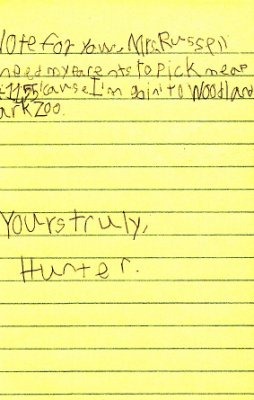 This is priceless.
He wrote a note for his teacher requesting early dismissal.
The note reads:
Note for you, Mrs. Russell.
Need my parents to pick me at 1155 ’cause I’m goin’ to Woodland Park Zoo.
Yours truly,
Hunter
I’m guessing Hunter isn’t enjoying school quite as much as we’d hope.
At least he didn’t sign it: "Hunter’s Dad".
September 9, 2007 Leave a comment
Newsweek points me to "The Autism Spectrum Quotient", with interesting results.
September 1, 2007 Leave a comment
.. or still live in your Mom’s basement.
No need for the babe you met at the drive-in window of Jack in the Box to not think you’re a player who owns a crib with a view.
Well, finances, that is.
Teasing. This works for the player above, or for the artsy urbanite; Adam Frank brings us "Reveal":

August 31, 2007 Leave a comment
Okay, I know. I’m from the ‘Watergate‘ era, during the Nixon years.
Since then, we’ve had:
Now I’m hearing WikipediaGate.
Essentially, it describes the situation created when an article is edited to benefit an individual or organization. This could be someone who writes their own, inflating their contributions, an organization removing unfavorable bits about itself (or hiding the truth entirely), or any number of similar, FBO entries.
Up until recently, most anyone with an account could edit an article on Wikipedia. Entries and updates were rudimentarily tracked.
Then, along came WikiScanner, a nifty tool that tracks who (by IP and other means) posted what, when and where.
Allegedly, CIA and FBI computers were used to edit posts in Wikipedia. Topics include the Iraq situation and the prison at Guantanamo.
Not that I’m political (I’m really not), but: why would the government want to change articles?
As the changes will likely violate Wikipedia’s conflict-of-interest guidelines (duh), I suspect we’ll hear more about this by the outraged web as time goes by.
August 31, 2007 Leave a comment
On a recent trip to San Francisco for meetings over a few days, the sign drew us in.
The Bloody Mary itself was incredible, and provided enough vegetable matter to constitute lunch.


 OpsanBlog