My Hedonistic-Healthy Birthday (HHB) Weekend (2008)

Those close to me and read this blog heard me discuss the possibility of a gala event in Las Vegas, tentatively titled “Michael’s Hedonistic-Healthy Fiftieth Birthday Weekend”.

Yeah: I am about as effective at product names as is Microsoft.

:: runrunrunrunrun ::

I admit, I had lofty plans. A number of guys, a few stand-up broads, a-la the Rat Pack:

  • On the hedonistic side: Some all-night gambling and Strip-walking, a show or two, some terrific food.
  • On the healthy side: Walk a lot, sleep in a day or two, extra gym time, pool time, walk some more.

However, the lofty plans of mice and men can, well, deflate in the face of reality, schedules and real life. So, in short, the guy trip unraveled, the stand-up broads sat down; you get the drift.

In the end, I realized that I just didn’t want to be responsible for anyone’s good time but my own. Selfish? Yeah. I earned it .. for this one weekend, I get to play.

So, I set my own agenda. Here’s what I wanted to do:

  • Two one-hour sessions on the cross-trainer each day.
  • Pool time, complete with sun and Mai-Tais.
  • Sleep in and take an afternoon nap.
  • Multiple walks, including at least one all-nighter.
  • Dinner at my favorite steak house on The Strip.
  • Dinner at Marrakech (this is as much a fact-finding mission as a meal: I want to make that dessert at home).
  • Lose weight during the trip.
  • Spend only House money during the trip.

Lofty agenda. Here’s what I did:

  • Two hours on the cross-trainer each day; three hours on two days. :: strut :: Check.
  • Pool time: a bit of a disappointment; relatively bad weather for the pool (wind and temperatures in the low 60s). However, I still managed to get two hours in the last two days .. but, no Mai Tais. With an “A for effort”: Check.
  • I didn’t sleep in or take any naps. I know myself well enough to realize that I feel like I’m missing something when I sleep. Expected behavior.
  • I took lots of walks (check out My SportsDo Activity Blog for October 11-14th, 2008). Sadly, didn’t do the all-nighter .. if you can believe it, I found I was too tired with all the other activity. I’ll make that up on my next working trip to Vegas. Rationalized with reality behavior.
  • Dinner at my favorite steak house on The Strip: the Steakhouse at Bill’s Gamblin’ Hall. It’s in the okay-to-decent realm; no where near over the top. Good food: some table side dishes and a reasonably-priced wine menu. The staff knows me there and takes very, very good care of me. It also has the bonus of being within a block of my hotel, the Westin Casuarina. Check.
  • Dinner at Marrakech. The experience was so much fun, I wrote a separate post, “The HHB Weekend: Dinner at Marrakech” which contains all the details. Check.
  • Spend only house money during the trip. Almost. Room, meals, tips, incidentals: covered with cash. I paid for airfare with miles and upgraded using my card; about $150. The rental car was on a complimentary weekend rental, plus one day at the weekend rate; about $45, with gas. I came home with $200 over my stake. Who da man? Check.
  • The car I hired to take me from the airport back to my hotel after returning my rental car: covered with cash (damn it). Why did I do that crazy thing? Well, left my wallet in the room. Who da dumbass?
  • The crazy crystal cube with my 3D visage in it (I’ll share it, if I can figure out how to take a picture of it): covered with cash.

All in all, a wonderful trip and the ideal way for me to have spent my mid-life-point birthday.

Original Post: November 1, 2008

More Frightening than "Three Little Words"

If you’ve heard me speak, you know I give a quick example (a diatribe, really) about how the new three little words strikes fear into everyone’s hearts. Those words?

On the Web“.

I mean pictures, videos, messages of, and about you, on the web. Scary? You bet!

For the record, the old TLW used to be “I love you”. 😛

All that said, here’s some new scary words for you .. far more than three words, though. This came in last week via USPS:

We are writing to let you know that computer tapes containing some of your personal information were lost while being transported to an off-site storage facility by our archive services vendor.

Now, that’s scary. Let’s discuss:

  • They’re trying to avoid fault by stating “by our archive services vendor“.
  • They’re creating fear by stating “your personal information“, with all the issues surrounding identity theft.
  • They’re assuring us they have remote backups (John and Jane may not get this, but I do), which is usually a good thing.
  • Tapes?!?

Then:

While we have no reason to believe that this information has been accessed or used inappropriately, we deeply regret that this incident occurred and we wanted to explain the precautionary steps we have taken to help protect you.

Umm:

  • “.. we have no reason to believe that this information has been accessed or used inappropriately”: Optimistic, at best. How do they know if they can’t find the tapes? Are the tapes in their possession now, or are they still missing? If recovered, can they tell if the tapes were read or restored to a system?
  • We deeply regret“: Wow. An apology (sort of).
  • .. explain the precautionary steps we have taken ..“: Sorry kids, but precautionary means you planned something in advance, not reacting (as you are) to a situation you (oh, sorry .. your vendor) created.

Then comes some background into the kind of information that was lost; in this case, stockholder information for publicly-traded companies. They didn’t specify which companies, however, I’ve only worked for one publicly-traded company, and that was Microsoft.

Next (this was in bold, by the way):

Please note that while the timing of this notice was affected by our forensic investigation into the nature and scope of this incident, based on information received to date, we have no reason to believe your information has been or will be improperly accessed or misused as a result of this incident.

This is fun now:

  • .. timing of this notice was affected by our forensic investigation ..“: what the Hell does this mean? Did they anticipate the data loss and are sending this in advance, or did they want to get the notice into the mail as soon as they discovered the loss? In the finance world, “forensic” typically means the analysis of statements, and logs, cross-referencing them against the universe of facts, like date, time, location, who benefited, etc.
  • .. we have no reason to believe ..“: Folks: they have no idea. Not sure why they want to say this again (especially in bold).
  • “.. as a result of this incident ..”: “This” incident? There are others? Gawd.

Unbreakable” is a great film in which Samuel L. Jackson plays a physically-challenged cynic. He tells Bruce Willis that when someone has an offer that’s too good to be true it will follow with an ask for a credit card number.

Surprise, surprise. No free lunch, in other words.

Back to my letter. This vendor (yes; it’s from a vendor) doesn’t ask for a CC number .. in fact, they offer a two-year subscription to their usually-for-pay, identity-theft-protection and credit-notification service as a means to repay for their mishandling of my records.

This suddenly raised the question with me: Was my data ever actually lost, or is this just a come-on for their service? I’m a pragmatist, not a cynic .. but I can’t help to think something could be fishy here.

Further, what if their Terms of Service (which, nobody reads anyway) includes an indemnity clause that prevents further action against them if I accept the service. This was one ToS I read very, very carefully. Candidly: the cynic in me was (almost) disappointed that it didn’t. Would have made for a far more interesting post.

Did I sign up? Yes. I did sign up for the free service. Why? Well:

  • It was offered with no risk (they didn’t ask me for a credit card number).
  • It seems quite comprehensive (i.e., all credit agencies and credit-related actions).
  • It’s quite interactive, including alerts for changes to my credit rating, including inquiries, “potentially negative” events (I had to report a CC lost this past week, and the service notified me).

I’ll let you know how it goes.

Original Post: September 28, 2008

What is it with summer time food ..

.. that you must wear to truly enjoy? I’m thinking:

  • Ribs
  • Corn on the Cob
  • S’Mores

.. what are you wearing for dinner tonight? 😛

Original Post: August 11, 2008

The Newspaper is Dead

Long live the newspaper!

Nope .. not like me at all. This is me:

  • While I appreciate the USA Today that finds its way to my hotel room door, I usually pass it by.
  • There are times at the gym that my Zune battery is dying or in the waiting room and my mail is caught up.
  • Those pretty pictures sometimes catch my eye and I skim through the articles.

The bulk of the time (even by an overly-optimistic 80/20 rule), the newspaper is irrelevant to me.

So, where is the value of the daily rag? Is it:

  • with older-than-50-somethings (for the record, I’m 50) as their primary source of news?
  • with folks who simply refuse to “connect”?
  • with folks who just like to get their hands dirty?

Besides hotels, who is buying enough newspapers to keep the industry alive?

In short, no one. Like all businesses facing the power of the Web, newspapers have to adapt, or become extinct.

One way to keep a profitable bottom line is to reduce staff .. but you need to reduce the right staff. With automation, you probably don’t need as many printers, but you need enough folks to run the machinery. This leaves assistants, sales people, managers, editorial staff and reporters .. the latter two being the most critical to maintain content quality.

I’m afraid to ask which groups the newspapers have cut .. there is a site called Newspaper Death Watch with all the latest stats (update to the 2008 version of this post).

As to evolution, the blogosphere is full of “me too” types. Now, I raise my hand: guilty as charged for a 1/3 of my content. Many bloggers just read news and other blogs and then post their opinions about them. In my defense, I post the link either as a supporting story, or I’ll make a glib comment and expect the reader to make the connections that are relevant to them.

However, the “me too” folks need something with which to start, and that something is a news story, captured by a reporter, edited by an editor and published in one form or another. Our news consumption would suffer greatly if we cannot retain / replace the news generated by the newspaper industry.

So .. the problem is not editorial or in content generation, it appears to be in deployment. Can the newspapers afford to race to an all-online model before they run out of dough?

SearchEngineLand posts a detailed commentary of the newspapers’ plight in “Can Newspapers Be Saved?” (2008 reference).

What do you think?

Original Post: August 18, 2008

Free Wi-Fi: Safety and Security be Darned!

You probably already know that Starbucks offers Wi-Fi free of charge at their locations. Some exceptions include ‘franchise’ stores like those at airports (which are typically belong to the food service provider that owns the relationship with the port).

There is a ton of free Wi-Fi out there; intentionally, or not. Access is available legitimately, or by “Wi-Fi Roguing” (stealing wireless Internet from unprotected networks) to private networks.

When looking (in advance, of course) use your search of choice; start with “WiFi zip code” in a search box; both Bing and Google will provide you a list.

So now you’ve found some Wi-Fi .. but you should be concerned that non-commercial / non-sponsored Wi-Fi may not be secure.

Free Wi-Fi at Starbucks, Panera Bread or some other gathering place, falls into the ‘sponsored’ category, as does your local coffee shop, community center, etc. I would expect sponsored Wi-Fi to be legitimate; safe from folks who might collect credentials. Since you really don’t know the operator, this is a risk, and your corporate IT may suggest / insist on the use of a Smart Card or secure proxy.

When roguing, you’re totally at risk when you connect to an unknown network; whether owned by random private individual whose condo is in range, or some punk with a laptop putting up a familiar (think: ‘linksys’, ‘netgear’ or “Free Public Wi-Fi”) SSID.

Hell, even commercial SSIDs run the risk of being spoofed. See “Wi-Fi Access Point or Account Credential Honeypot?” for a detailed walk-through of my observations in range of a (most likely legitimate) AT&T public Wi-Fi hotspot.

If in doubt, don’t connect.

Original Post: October 15, 2007

Wi-Fi Access Point or Account Credential Honeypot?

I shouldn’t have to say this as we all know better, but here it is: We need to exercise caution when connecting to ‘foreign’ Wi-Fi signals.

I’m no stranger to ‘roguing’, but I’ve recently become aware of significant security risks associated with connecting to unknown networks. Here is some food for thought:

WAPHoneyFreePublic20060818You’ve seen this image before, I’m sure. It’s a peer-to-peer (computer-to-computer, versus access point-to-computer) networking icon. You should NEVER (except under the circumstances when a known and trusted user is sharing their connection with you), connect to a wireless signal that has the peer-to-peer icon.

You may see these icons when looking for Wi-Fi signals in busy public places. They are broadcast because of an unusual feature of older Windows versions wireless network stack that causes a computer to broadcast the last-connected SSID when not connected to a wireless network.

I STRONGLY suggest you edit the advanced properties of your wireless network card to connect ‘to ‘Access point (infrastructure) networks only to filter them out.

WAPHoneyWiFiList20060818My flight was delayed at SeaTac the other day, so I did my usual “is there a wireless network in the building in the building that I trust" search. I have a T-Mobile account, and sometimes I get lucky. In this case, there wasn’t.

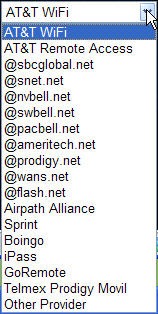
However, there was a seemingly-helpful AT&T access point in the building. Nothing against AT&T, it’s probably a legitimate hotspot. But their login page was interesting, offering a list of ‘other providers’ (presuming a reciprocal relationship with AT&T), on the left.

It’s a healthy list, but none of which I have an account. Ah, being helpful, there’s an ‘Other Provider’ link at the very bottom.

Once you find an Access Point, you should NEVER connect to a wireless network using your credentials from another wireless network (i.e., T-Mobile via xyzzy Wireless) unless you enter your credentials into your native wireless account logon page (I have seen services that do this, redirecting to a T-Mobile login page that ‘advises’ the local wireless the account credentials are valid).

You have no idea how your credentials are being used. If you post your credentials to a foreign wireless site, you have just given your login and provider information to an unknown party who might use it for illegitimate or illegal purposes, leaving you to hold the bag or pay the bills.

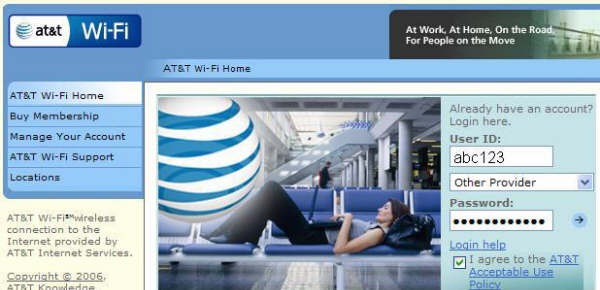
To finish this story, I filled out the login page like this (I didn’t log in, of course):

WAPHoneyATT20060818

Let me point out that it would take a mediocre hacker about ten minutes to set up a page and host it on a laptop with a web server in an airport. In a busy public area, I’m confident a hacker could collect a pile of logins in just a few hours. Make the login experience compelling enough, including enough providers and data-hungry travelers will happily post their credentials rushing between planes. A polite "we cannot confirm your credentials at this time" message, and the traveler is none the wiser.

Be wireless-safe, people.

Original Post: August 18, 2006

The ULTIMATE Fashion Statement while Wi-Fi Roguing

Or, at the least, the apparel to demonstrate you’re able to connect.

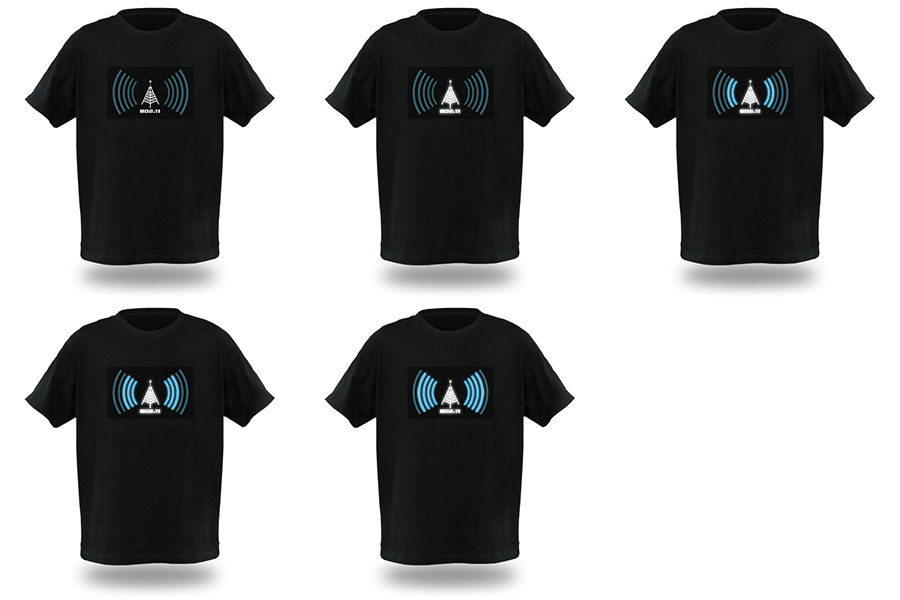
wifi_shirt_anim20071009You remember wi-fi ‘roguging’?

It’s the fine art of connecting to wi-fi networks that aren’t yours.

Granted, not all connections to wireless networks are, shall we say, inappropriate, but here’s a cool way to detect a network without whipping out your laptop.

This shirt lights up when you’re within wi-fi range.

It doesn’t discern between secured and open networks .. you’ll have to sort that on your own.

ThinkGeek gives us the “WI-FI Detector Shirt

Original Post: October 9, 2007

Forbidden Lego Projects

Some look downright dangerous, actually. This is a video of a brick shooting gun on YouTube:

I’m hiding this post from Hunter, though: his last Lego project was an airplane that never quite got off the ground.

But .. what if it had fuel? 😉

Forbidden projects are said to be those projects the master builders work on ‘in the back room’.

Unlike the safe-and-sound master builder projects (did you see the cool Harry Potter model a few years ago?), these can run in the realm of, well, dangerous.

The MBs combine bricks, modified building techniques and in a pinch, household materials.

Previous projects include a catapult, ping-pong ball launcher and gun.

Don’t try this at home, folks. Well, unless you buy the book, of course.

Original Post: August 28, 2007

Integration Architecture and the Baggage (mis-) Handlers

This is a bit of a stream of consciousness post. No agenda; it’s just something I observed and extrapolated into (near-) relevancy.

There’s the plane.

Then, there’s the conveyor belt with a guy at each end; one who loads the incoming bags on the belt, and the other who grabs them from the belt and swings them onto the waiting trailer.

When the trailer fills (or the plane empties), the truck comes over and hauls it off to Baggage Claim.

It’s a dance. Can be amusing to watch, though. Beneath the grins, it’s a system rife with opportunity for error. Consider:

  • There’s only one door, so the physical world requires the guy on the plane to move further away from the door to fetch more bags.
  • If the belt gets ahead of the guy on the ground, the bags get to the ground, too. Sure, he can stop the belt, but if he does, the guy in the plane gets held up.
  • If the trailer is full, the belt must stop.
  • If the truck is busy, the trailer sits.

Once unloaded, it all happens in reverse.

The airline needs to turn (unload, reload and go) a plane quickly. You may assume outgoing bags are loaded onto a trailer at the terminal and delivered to the plane, even while incoming bags are still being handled. Consider:

  • What if you’re short handlers? Bags don’t move on / off planes, onto belts or into / out of trailers.
  • What if you’re short belts, or a belt is out of service? Bags don’t move on / off planes or in / out of trailers.
  • What if you’re short trailers? Bags get handled twice, and are left on the ground, either coming or going.
  • What if you’re short trucks? Bags sit on loaded trailers. Empty trailers sit where they don’t need to be.

Then, there’s the endpoints:

  • The plane is early: resources (handlers, trailers and trucks) are redirected, putting other arrivals / departures at risk.
  • The plane is late: resources (handlers, trailers and trucks) wait, or are redirected. Outgoing bags wait somewhere, along with the handlers, trailers and trucks.
  • The guys in Baggage Claim are behind; the loaded trailer sits, which holds up loading bags that need to be on an outgoing flight.

Each connection represents a potential choke point: a place where the process runs the risk of coming to a halt. Failure at any point will impact other parts of the system, causing delays.

I’m just so glad I pack light enough to carry on.

I didn’t write this to complain about baggage handlers. Rather, how about we imagine modeling this a data workflow? What would you do to protect against delays in the system?

Note there are components in place in this system to mitigate some of the risks of delaying the process:

  • Belts reduce the distance a handler must travel, increasing capacity and saving time. Time = money.
  • Using trailers rather than trucks (trailers can be left at endpoints) creates a buffer in which bags can be stored, for short term intervals.
  • Using trailers also reduces the number of trucks and drivers while increasing truck utilization. The accountants will enjoy maximum utilization of a capital expense.
  • Proper staffing of handlers at both the ends of belts and in Baggage Claim keeps things moving.

Some rough equivalents for a workflow architecture:

  • Bags: data, packaged in a mostly standardized form (the real world just sucks sometimes).
  • The plane baggage compartment: data / application silo in which users can create, manipulate and store data. The plane baggage compartment has a finite capacity.
  • Belts: FIFO queue (first-in-first-out queue) with finite capacity and known duration to offload data packets from the data / application silo.
  • Trailers: LIFO stack with finite capacity. A stack is essentially a LIFO queue, accepting data packets from the belt queue, but rather inefficiently: the last bag in is the first bag out by default. However, there can be exceptions: see Handlers, next.
  • Handlers: processes with finite capacity and the power to evaluate data packages (i.e., reading certain baggage tags for expedited handling). Premium tags are placed in a place in the trailer so they can be retrieved first by the handlers in Baggage Claim, rather than the standard LIFO treatment.
  • Baggage Claim: data / application silo that serves processed data back to users (or to other systems).

Use of components like queues and stacks can enable your workflow architecture to scale to Internet capacity. You should establish service-level agreements (SLAs) at each touchpoint to ensure you’re sending / receiving data in an acceptable timeframe and in the proper formats.

In past lives, I worked extensively as an Integration Architect. This was in the days before Windows Workflow Foundation and BizTalk. BizTalk 2004 was a godsend: in fact, I still have a current BizTalk 2006 implementation on a VPC with which I tinker when I feel the need to code. It’s not as sexy as a hot web application built in Silverlight or WPF, but it keeps me thinking of ways to add business value by integrating data trapped within cranky silos with other applications and end users.

A data model, application architecture or process workflow works the best when it’s modeled as close to the real-life process it represents. Once modeled, you can look closely at ways to improve it in an iterative fashion.

Original Post: October 2007

Live Rube Goldberg Machines

My Hunter is keen on all things Rube Goldberg.

These two involve:

  • A slinky
  • An umbrella
  • A vibrating cell phone
  • A chessboard
  • A dart board
  • A few bottles of wine

For what more could you ask?

Bayham & Tyers (a now-defunct company, but a still-living partnership) gives us two videos: “The Contraption” and "The Contraption II".

Now, at a far-higher production cost (I’m guessing) OK GO released a YouTube video of “This too shall pass”, another live-action Rube Golderg Machine.

Original Post: June 28, 2007; updated June 6, 2011